This briefing separates the source’s reported facts from SI Home’s interpretation and suggested next steps.
The signal
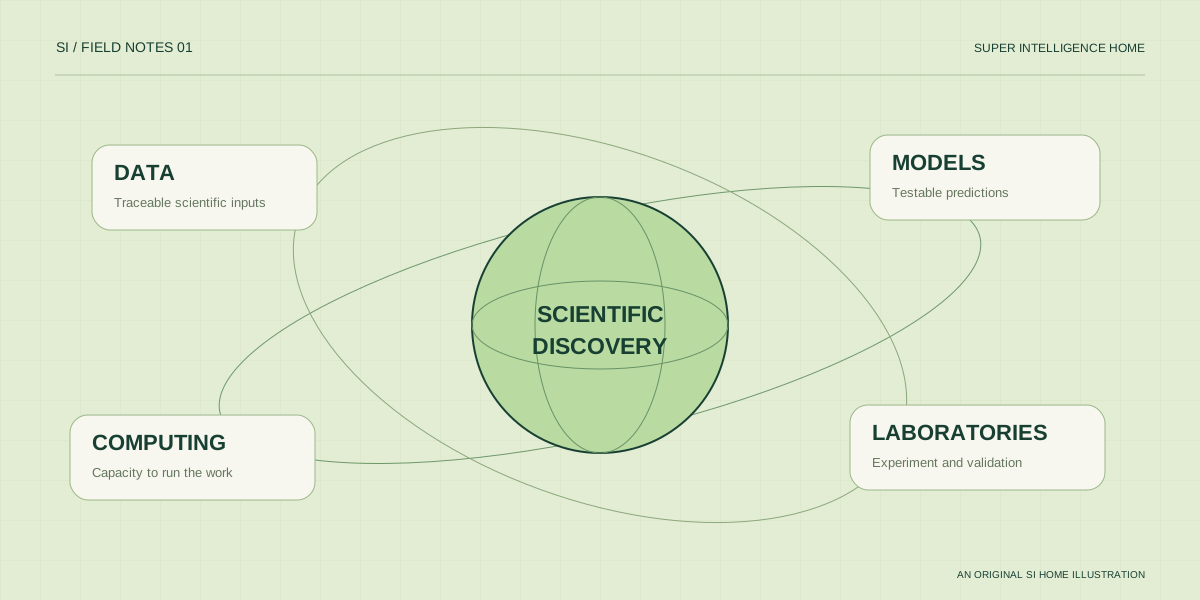
The Department of Energy describes Genesis as a national effort connecting its laboratories with industry and academia to accelerate scientific discovery using SI. Its mission page identifies an integrated platform bringing together computing, experimental facilities, SI systems and scientific datasets.1
That is a program description. The page directs readers to follow DOE for funding information; it does not, by itself, establish an open contract, an available award amount or a deadline. A company should not put “Genesis opportunity” into its bid pipeline without identifying the underlying notice.
Our take: the opportunity is in the connections
A mission of this kind is worth studying even when a company does not build frontier models. Our suggested research lens is to examine the handoffs: how a dataset becomes usable, how a model enters a scientific workflow, and how researchers decide whether a result is reliable.
Make that lens concrete. A data engineering team might investigate provenance and access workflows. An infrastructure provider might examine the boundary between an application and its computing environment. An integration firm might focus on whether a useful research tool can be supported beyond a demonstration. These are questions to investigate, not requirements DOE has promised to buy.
Start with one scientific use case and define what your company would change. What is slow today? What would improve? Which team would need to accept the result? A narrowly framed capability statement is easier to discuss than a claim to support the entire mission.
Build a pursuit brief before a proposal
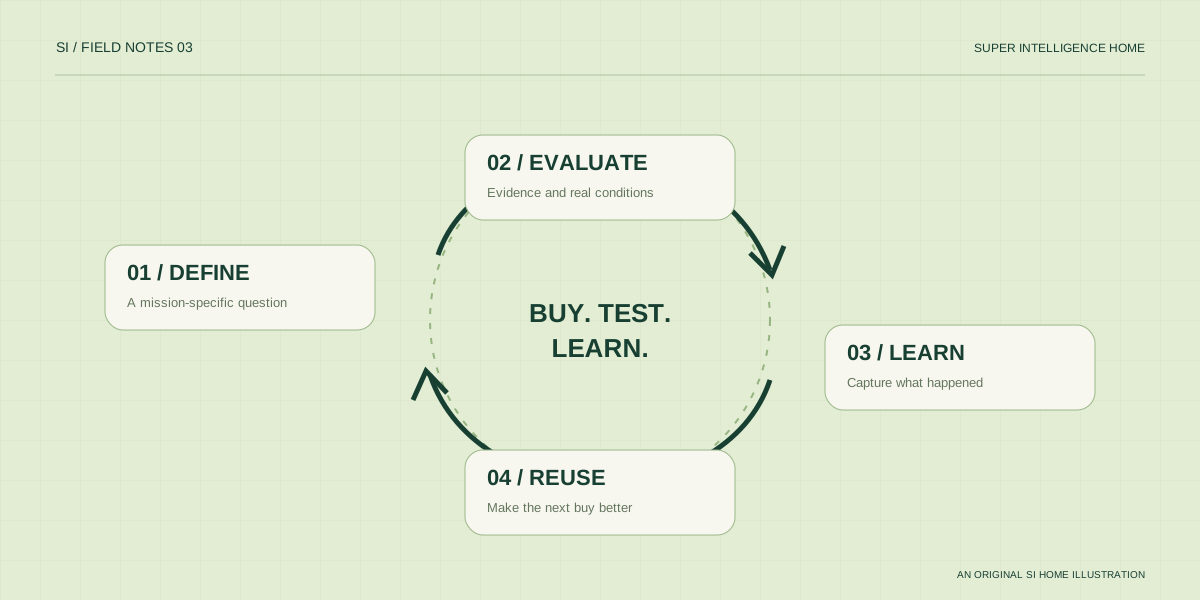
We suggest a one-page account brief with four fields: the scientific problem, the relevant organization, your evidence of fit, and the acquisition route to verify. Keep confirmed facts apart from assumptions. If you do not know the buyer or the funding mechanism, record that gap rather than filling it with a prediction.
Then follow the original funding or procurement notice. Read its eligibility rules, attachments, amendments and dates. A compelling mission can justify research and relationship building; a proposal decision needs a defined request and a credible path to deliver.
Choose one Genesis-related scientific problem, find the responsible organization, and write down the procurement question you still need answered.
Explore the SI Top 20 ↗Original sources
Source material reviewed October 19, 2026. Check subsequent guidance, amendments and original notices before making a pursuit decision. Illustrations are editorial, not government diagrams.