Civilian agency SI, shared purchasing, and federal research. What’s moving, who to follow, and how to find the right route.
SI
SI Home editorial deskReviewed October 19, 2026 · Public agency briefing
An editorial map for account research. A program announcement, purchasing agreement, or research resource does not by itself establish an open procurement.THE SIGNAL / WHAT’S MOVING
Shared access. Agency-specific needs.
ACQUISITION SIGNAL · SEPTEMBER 2026
OneGov shapes the buying context.
GSA’s OneGov resources describe purchasing options for enterprise intelligence tools. In September 2026, GSA announced a new consumption-based OpenAI offer under that strategy.
Our take: Treat product access as one part of the account picture. Research the agency’s workflow, implementation needs, integration environment, and intended outcomes. Verify current pricing and eligibility at the source.
NSF’s 2026 NAIRR update describes access to computing, data, tools, and training for researchers. This is a research infrastructure pathway, not a general contract solicitation.
Our take: For a research team, useful access may be as relevant as a grant. Identify the resource, current application process, eligibility, and project requirements before treating it as an actionable lead.
Use GSA’s buying resources to understand shared purchasing options and procurement guidance. A government-wide vehicle can serve multiple agencies; confirm which buyers are eligible and how a specific order is placed.
For health, transportation, public services, and other civilian missions, identify the actual program sponsor and contracting office in the notice. Search SAM.gov for requirements and market research tied to your capability.
Follow NSF’s NAIRR resources for research computing and related support. Read the specific application instructions rather than assuming that a resource allocation is a cash award or an acquisition opportunity.
Grants.gov provides federal funding search, while each notice defines the eligible applicants and required submissions. Separate grants and cooperative agreements from procurement contracts when qualifying a lead.
A stronger offer starts with the actual requirement.
Our acquisition briefings cover lessons from GAO and the source memorandum behind LLM procurement requirements. Use that context to ask better questions, then check what the current solicitation actually requires.
Qualify each lead by its current status, responsible office, notice identifier, eligibility, acquisition or funding route, and submission instructions. Past awards, policy documents, and program news provide context; they do not establish an open bid.
YOUR NEXT MOVE / CONNECT THE DOTS
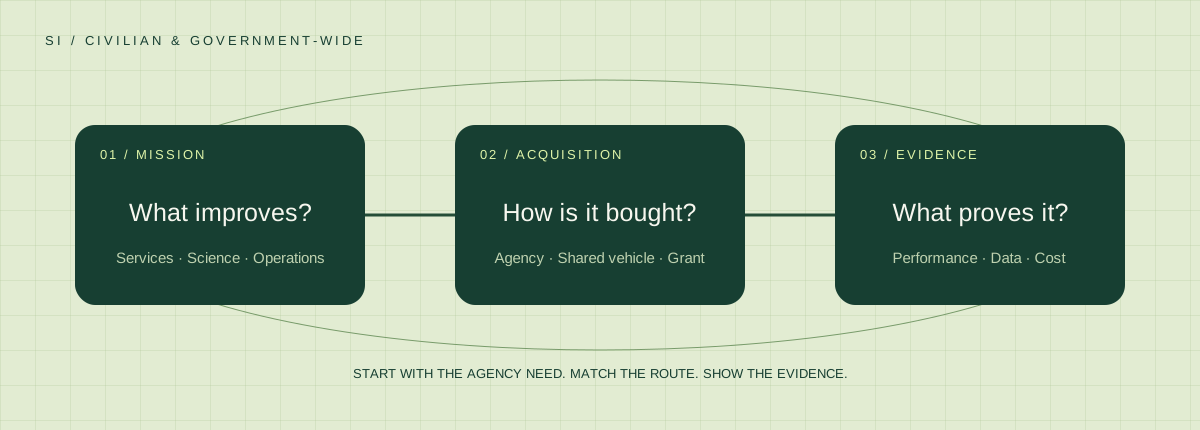
Choose one agency and one measurable outcome.
Define the mission fit. Explain the service, research, or operational problem you can address and how a buyer would measure success.
Trace the buying path. Identify the sponsor and contracting office, or the research program and funding notice. Check any shared vehicle requirements.
Prepare the evidence. Map your response to the published criteria, including performance, data handling, implementation effort, and cost.
SI Pro’s Research Library is members only. Membership access is being connected. Three introductory leads remain available in the free opportunity section.
Civilian covers non-military agency missions. Government-wide covers shared acquisition and policy that can also reach the military and laboratory lanes. These are editorial coverage areas, not mutually exclusive agency classifications.
Linked government sources support the reported facts. “Our take” and recommended next steps are SI Home analysis. SI is our editorial label for the advanced intelligence ecosystem, not a claim that an agency has achieved superintelligence. Source links retain their original addresses. Reviewed October 19, 2026; check the issuing agency for subsequent changes.